
How to Make Farmer’s Cheese
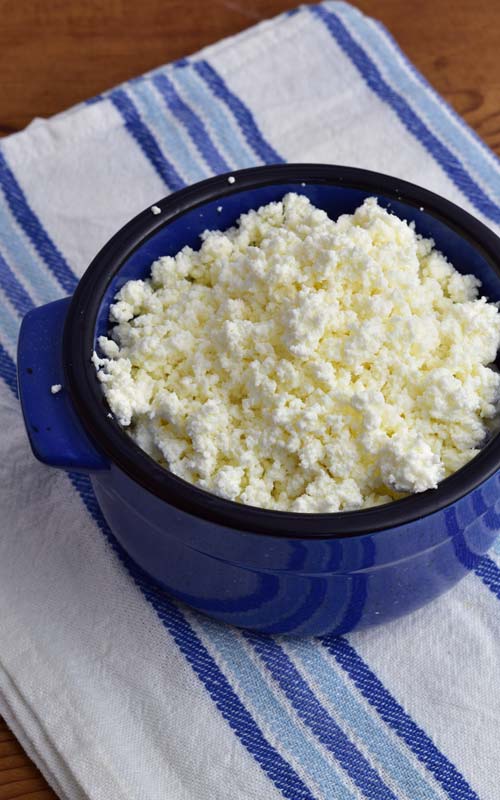
Farmer’s cheese is often called curd cheese. It’s incredibly easy to prepare at home, and if you haven’t tried it yet, let me show you how to make it.
This post was originally published in 2010, updated in 2019.
JUMP TO RECIPE | PIN IT for later
HOW TO MAKE FARMER’S CHEESE
This type of curd cheese is popular in Europe, like cream cheese in the US. However, unlike cream cheese, curd cheese is easy to prepare at home using milk, vinegar/lemon, and salt.
WHAT IS FARMER’S CHEESE ?
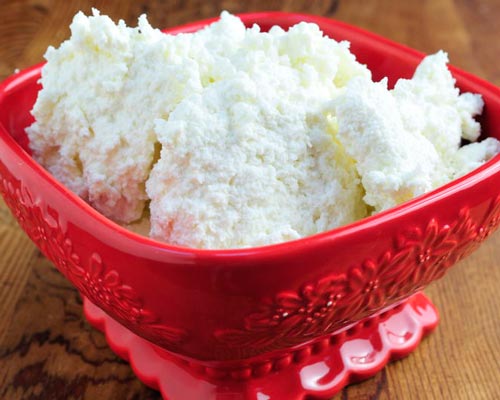
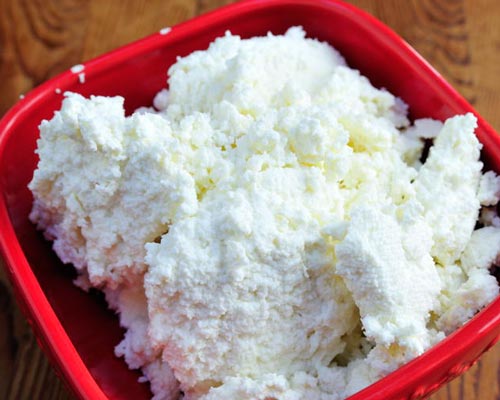
Farmer’s cheese is a creamy, slightly tangy soft curd cheese made by curdling milk with an acid such as vinegar or lemon juice. Texture can vary, depending on how much liquid is drained after curdling. You can control the consistency of the cheese – letting it drain overnight will produce creamy but denser and a bit more crumbly cheese, and allowing it to drain for just a short period (2-3 hours) will make the cheese less dense, very soft and smooth.
TO MAKE HOMEMADE FARMER’S CHEESE YOU NEED
- Candy Thermometer
- Fine Mesh Sieve
- Large Bowl
This post contains Amazon affiliate links that earn me a small commission, at no cost to you. I only recommend products that I use and love. Learn more about my affiliate policy here.
WHAT ARE THE INGREDIENTS FOR FARMER’S CHEESE
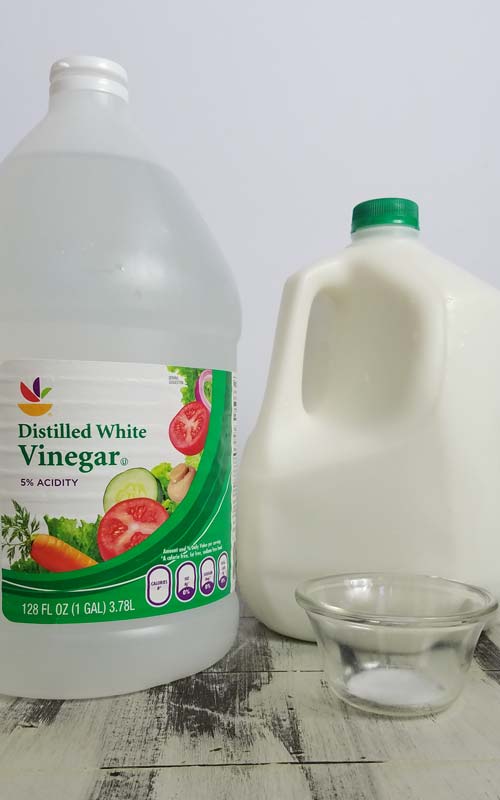
- Whole Milk (cow, goat, sheep) – for the best results, use whole milk. Low-fat or fat- free dairy produces rubbery cheese.
- Vinegar or Lemon Juice – these are interchangeable.
- Salt – don’t add too much if you plan on using cheese to make a dessert
TOOLS
Though not necessary, it’s helpful to use a candy thermometer to measure the temperature of the milk. You’ll also need a fine mesh sieve or a cheesecloth.
If you need a small amount of cheese, you’ll find a recipe for a small and a large batch on the recipe card. My picture tutorial shows how to make a large batch using 1 gallon of whole milk (about 4 liters). The process is the same for both.
MAKE CURDLED MILK
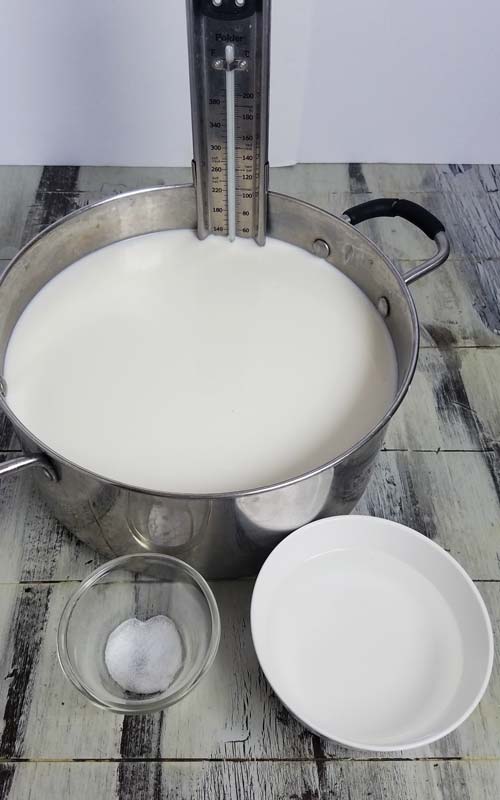
Into a pot, pour whole milk, add salt, and heat milk on medium heat. Stirring occasionally. If you use a pot that you know will burn the milk on the bottom, be sure to stir frequently so milk doesn’t bunt.
Heat milk until it reaches 180F. (83C) Then pour in vinegar or lemon juice, or a combination of both is fine, too. Turn off the heat and gently stir with a wooden spoon till you see curds forming about 30 seconds.
HOW TO MAKE FARMER’S CHEESE WITHOUT A THERMOMETER
You can still make this cheese if you don’t have a candy thermometer. Heat milk and watch it carefully. When you see a thin foam layer on the top and lots of steam rising from the surface of the milk, the surface might look like it’s moving back and forth. At this point, milk is very hot, almost boiling. It’s time to add vinegar or lemon juice.

You should see curds forming in a few seconds. Gently stir 2-3 times to ensure the vinegar is combined well with all the milk. Remove the pot from the heat and let it sit for 10-15 minutes.

DRAIN CHEESE
Place a large fine mesh sieve over a large bowl. Slowly pour hot curdled cheese into the sieve. Use a ladle or a measuring cup to pick up curdled milk from the pot. If your sieve is nearly full of curdled cheese, wait for the whey to drain, and then pour more curdled milk into the sieve to drain.
Cover with a plate or a kitchen towel and let curdled milk drain for 6-8 hours on the counter or in the fridge. This will produce denser, firmer cheese. If you prefer less dense cheese, let it drain for 2-3 hours.
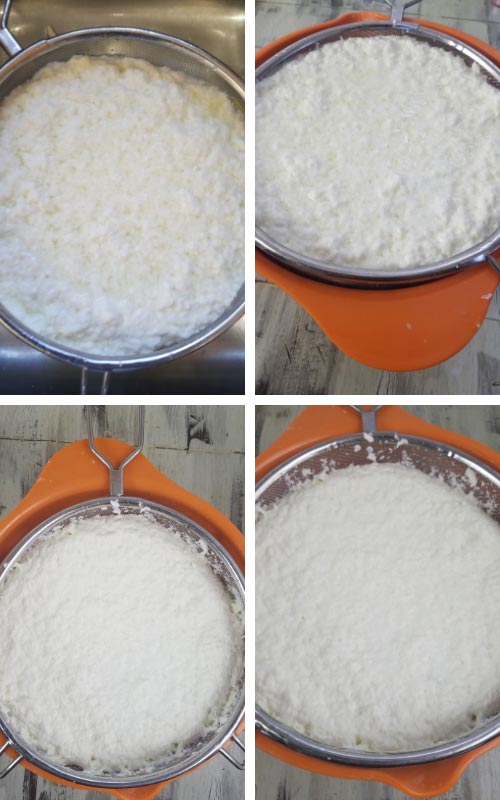
As a result, draining curd cheese will solidify and shrink in volume.

With a spatula, scrape cheese from the sieve into an airtight container. Cover with a lid and store in the fridge until ready to use. Kept in the refrigerator, farmer’s cheese will keep for up to 2 weeks.

HOW MUCH CHEESE DOES MILK YIELD?
It depends on the milk. I used a cheesecloth and a large strainer to collect the curds in the picture below.
- 4.5 liters (4.8 quarts, 1.2 gallons) of milk yields about 1150 grams (2.5 pounds) of drained, curdled cheese.

FARMER’S CHEESE SUCCESS TIPS
- Don’t boil the milk, but allow milk to reach near boiling temperature at least 180°F/82°C.
- Heat milk slowly enough so that it doesn’t scald.
- It’s okay to stir the milk while it’s heating up to help prevent scalding.
- Can I make farmer’s cheese with goat milk? Yes. You can use cow, goat or sheep milk.
- How long does farmer’s cheese last? Homemade curdled cheese lasts in the fridge for up to 2 weeks.
- I don’t have a thermometer; how can I tell when to add acid to milk? Heat milk on medium-high heat, stirring frequently. When you see a thin foam layer on the top and lots of steam rising from the surface, the surface might look like it’s moving back and forth. At this point, milk is near boiling point. It’s time to add vinegar or lemon juice.
- What kind of vinegar should I use? White distilled vinegar.
- Can I use low-fat or fat-free milk? Low-fat and Fat-free milk both produce rubbery curd cheese. I don’t recommend using them.
- Does farmer’s cheese melt? No, this curd cheese will not melt like mozzarella.
- Where can I buy it? Most European stores carry curd cheeses, though not all are the same. Friendship Farmer Cheese is the closest to my curd cheese recipe. It is sold at most grocery stores here in the United States.
- Can you bake with farmer’s cheese? Absolutely. I bake with it all the time. It’s my go-to cheese to make Kolache or a Layered Grated Cheese Cake.
- I’m not a fan of the texture. Can I make it smooth, like cream cheese? Process 1 cup of drained farmer’s cheese with 3-4 tablespoons of milk or water in a food processor, blender, or immersion blender.
- Can farmer’s cheese be used in lasagna? Yes, you can use it to make easy skillet lasagna (via Midwest Foodie Blog). I also use it to make lasagna rolls.
- Is it the same as ricotta cheese? Though similar and interchangeable in most recipes, the real ricotta is made from whey, whereas Farmer’s cheese is made from curds from milk.
- Is there a substitute? If I don’t have time to make this delicious curd cheese from scratch and you can’t find it in the store, use Ricotta instead.
DELICIOUS RECIPES USING FARMER’S CHEESE
- Sweet Cheese Balls with Toasted Breadcrumbs
- Kolache
- Layered Grated Chocolate Vanilla Cheesecake
- Sweet Potato Cheese Flan
- Flour Dumplings(Spaetzle) with Grilled Cherries and Cheese
- Cheerios Strawberry Cheese Tart
- Farmer’s Cheese Carrot Dill Spread
Farmer’s Cheese
Ingredients
Small Batch Farmer's Cheese
- 1 quart full fat milk (4cups, 1liter)
- 2½ tbsp White Distilled Vinegar or Freshly Squeezed Lemon Juice
- pinch salt
Large Batch Farmer's Cheese
- 1 gallon full fat milk 3.7( circa 4 liters)
- 10 tbsp White Distilled Vinegar Freshly Squeezed Lemon Juice
- 1/2 tsp salt
Instructions
Farmer's Cheese
- Into a pot pour full fat milk, add salt. Attach a candy thermometer on the inside of the pot. Don't have a candy thermometer? Check my notes for solutions on how to make farmer's cheese without it.
- Heat the milk on medium heat, stirring occasionally to prevent burning on the bottom of the pot. If you are using a pot that is notoriously difficult to cook in and it burns food constantly be sure to stir frequently or use a different pot.
- When the milk reaches 180F (around 82 C), pour vinegar in it, turn off the heat and gently stir the milk with a wooden spoon. You should see curds form almost immediately. Once you see curds forming, remove the pot from the heat and let the mixture sit for 10-15 minutes.
- Place a large fine mesh sieve over a large bowl or a pot. Then pour hot curdled milk through the fine mesh sieve. Let the liquid drain and sieve collect the curds. If your sieve is small you may need to wait a few moments for the liquid to drain before pouring in more curdled milk.
- Discard the drained liquid. Cover the sieve with cheese with a plate and let it drain for 5-6 hours. This can be either done on the counter or in the fridge. After draining, scrape out the cheese into a container and refrigerate until ready to use. Cheese should be refrigerated and will last for up to 2 weeks.
- Farmer's Cheese is a popular ingredient in sweet and savory dishes.
Notes
- How to make curdled cheese without a thermometer? -Oversee the milk once you see foam on the top and a lot of steam rising from the surface of the milk. And you’ll notice that the surface looks like it’s moving. Milk is very hot. Milk is almost boiling. It’s time to add vinegar.
- Can I use something else in place of vinegar? – You can use lemon juice. I, however, prefer vinegar as it doesn’t lend any flavor to the cheese and, therefore, it’s more suitable for a variety of dishes. If you don’t mind the lemon flavor, lemon juice is an excellent substitute for vinegar.
- How long does farmer’s cheese last? – Cheese stored in the fridge in an airtight container will keep for up to 2 weeks.
PIN IT for later

This post was originally published in 2010, in 2019, I updated this post with new process photos and written text, and a recipe card.

Hi, I’m Hani
Welcome!
Thank you for visiting Haniela’s. On my blog, you’ll find delicious sweet & savory recipes made with simple ingredients. Why not start a new adventure? Discover a world of cookie decorating with my step-by-step tutorials.

Hi, I’m Hani
Welcome!
Thank you for visiting Haniela’s. On my blog, you’ll find delicious sweet & savory recipes made with simple ingredients. Why not start a new adventure? Discover a world of cookie decorating with my step-by-step tutorials.





This recipe was easy to follow. I used unpasteurized cows milk, as I don’t have a source for sheep or goat milk. I have a tall spaghetti pot with a sieve liner & it worked well to drain. Any idea if I can add a tea bag when boiling the milk, for flavor?
Hi Debs,
Amazing. I’m glad you enjoy the curd cheese.
And thank you for your awesome question. I’m intrigued to try it myself, I love tea!
I would experiment on a small amount first. I think either cold brew overnight before the cheese is made or right after before straining the curds.
Hello
I need to try this recipe, I love all kinds of cheese. Could you please share the names of some recipes to make with this cheese. Thank you
Hello Michelle,
Yes, absolutely.
This cheese can be use in savory and sweet dishes.
Here are some recipe suggestions: kolache, cheesecake, cheese spread, cheese donuts, layered chocolate vanilla cheesecake, dumplings’ filling (sweet or savory), flour dumplings with grilled cherries and cheese, to name a few.
Hi there! I wanted to let you know that I tested a small batch of this using lactose free whole milk, and it worked wonderfully. I do have a question, however: What is the weight *approximately) of the finished cheese from using 1 gallon of milk? I have a recipe that calls for 1.5 pounds of farmers cheese, and I wonder if one gallon of milk will be enough? Thank you in advance.
Hi Emily,
this is so awesome. Thank you for sharing this with me. It never occurred to me try it with a different milk. What brand did you use? From regular cow’s milk – One gallon measure it usually yields to 4 cups of cheese, about 500 grams, which would equal to little over 1 pound. May I ask what is the recipe that calls for 1.5 pounds?
Thanks for your reply. I live in Denmark, so the brand of lactose free milk is a Danish one. The recipe I intend to make is for Paskha, Russian crustless cheesecake. They link your recipe for farmer’s cheese on their page for the cheesecake, which is how I found you. The link to their site is here: https://wholemadeliving.com/paskha-russian-crustless-cheesecake/
Thanks again for your response 🙂
Thank you Emily.
I’m using this in a lasagna, what would happen if I didn’t drain all the whey? I’m liking the consistency with some left as it’s not solid. I’ll be adding a 3oz brick of farm cheese I made previously and then mixing in my chredded mozza, parm, egg, etc. .
Thanks!
Hi Taylor,
I haven’t used it partially drained in lasagna so I’not 100 % sure. But I think it makes total sense, farmer’s cheese when drained is pretty dense so leaving some whey in makes it more pliable and easier to mix with other ingredients – cheese, egg etc. As long as the consistency is right when you mix it with all the other ingredients – moz. cheese, egg etc I think it should be fine. Keep me posted.
Now I want to make lasagna myself. Yum.
I love zucchini pasta rolls, those are so yummy with the cheese.
If I want the farmers cheese to be less sour could I add less vinegar?
Hi Jackie, you can also use lemon juice. I haven’t tried it with less vinegar but I’ve seen recipes that use less, so I’d say yes you can use less just be aware the curd formation maybe less productive. I need to test it with less vinegar. Have you made it before and did you find it too sour tasting? I’m just curious. Thank you.
A million years ago, Weight Watchers used to list Farmer's cheese in their menu plans–I'm talking early 70's–and you could find it in the store, but it was dry and tasteless. This certainly seems like a good alternative–If you are using store bought buttermilk, do you only need the 9 Tbsp. ? Thanks. Ellen
I have a Ukrainian recipe for making farmer's cheese but takes 3 days to make! This recipe is so much quicker! Thank you for your tutorial.
Thank you! Farmers cheese is so hard to find around here and so expensive. I make vereniki (like perogi) with it. Now it's nice to know I can make my own!
I've never seen farmers cheese before…it's a must try!! Does it taste like Labneh/Labna cheese? Thanks for sharing this 🙂
Faithy, great to see you stopped by, well as for the liquid…it doesn't really smell that good, I suppose it is sour. I have never tasted it.
As for the lemon, I have only tried this recipe with vinegar, and I read somewhere that lemon is not good for this, I haven't tested it yet, I might try that just to see if it really is true.I mentioned that only because I haven't used it and I'm not 100% it would work with lemon as well as with vinegar. I was reading more last night about cheese making and I have a feeling that article that stated that you can't use lemon was wrong, I'll let you know how it goes when I try lemon.
This is very insightful! Looks like cottage cheese to me! I didn't know that's how you make farmer's cheese but now i know. I have always wondered what is farmer's cheese! Why is it that we can't use lemon juice to make farmer cheese but it is ok when making buttermilk? I wonder how the yellow liquid taste like though..is it sour?