
Easy Marshmallow Fondant Recipe |Video|
I’ve been using marshmallow fondant for years, and it’s still one of my favorites. It’s easy to make with just a few ingredients and works beautifully on cakes, cupcakes, and cookies.
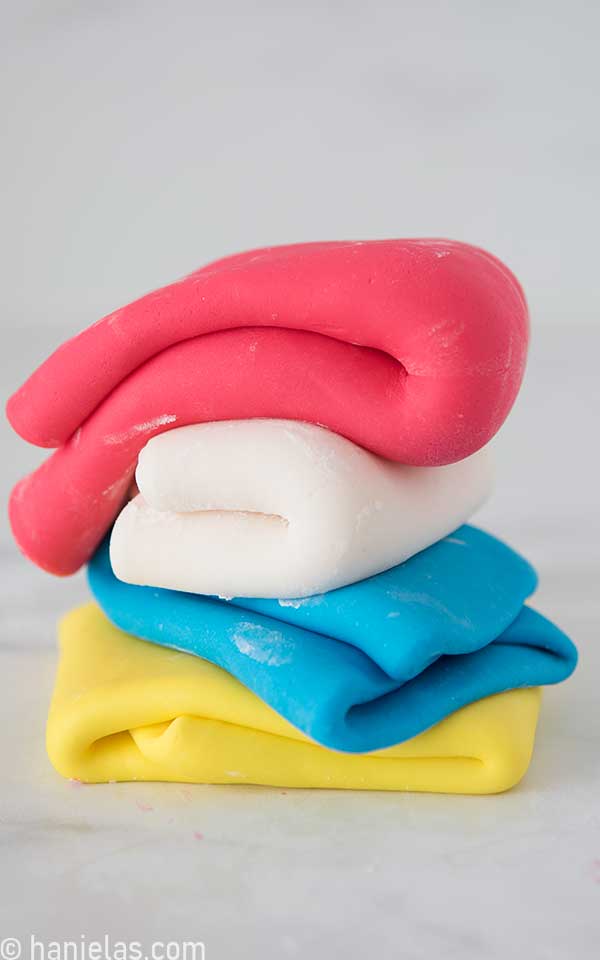
WHY I USE THIS RECIPE
- Simple to make – Marshmallow fondant comes together in minutes. While many recipes use mini marshmallows, I often use regular or even large ones with great results.
- Easy to flavor – You can customize the taste using extracts, emulsions, or oil-based flavorings for a delicious taste.
- Easy to color – Warm, melted marshmallows take on color beautifully, making it simple to create large batches in any shade.
- Quick to turn into gum paste – Add tylose to transform fondant into gum paste in just minutes.
- Long-lasting – When well wrapped and stored in the fridge, it keeps for up to 2 months.
FONDANT INGREDIENTS
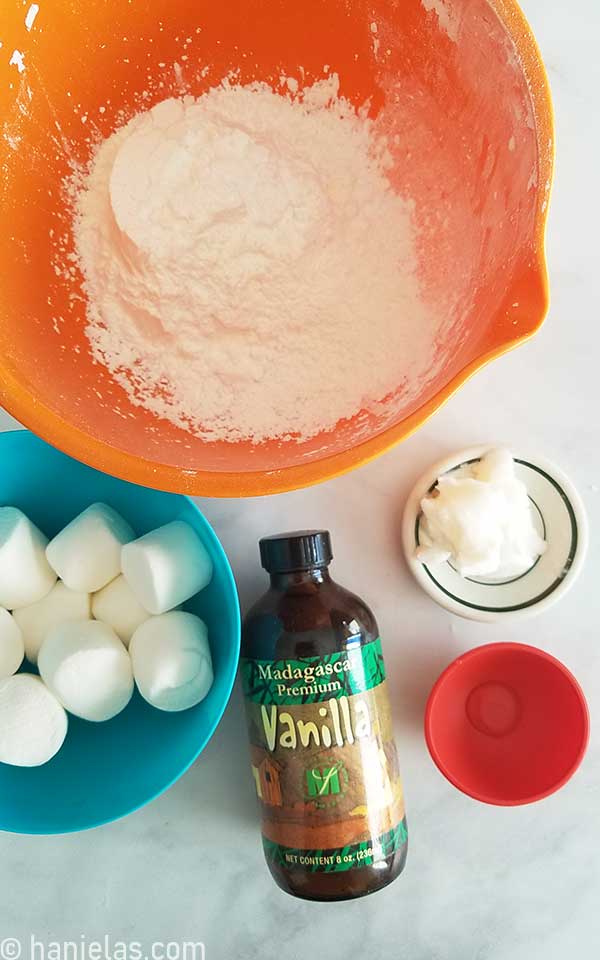
- Essential Ingredients to Prepare Fondant
- Marshmallows – use minis, but if you can’t find them, standard-size marshmallows are fine too. Or you can cut up the extra-large ones with kitchen shears.
- Powdered sugar – it’s super important that it doesn’t have lumps. I always sift it if I see lumps.
- Water – It helps melt marshmallows more evenly and thins the thick, melted marshmallow mass so it’s easier to knead with powdered sugar. Water is also used to hydrate marshmallows and make fondant less prone to tearing. It can be used to mitigate elephant skin.
- Flavoring – While you don’t need to use flavoring, I like to use extra Vanilla to make it taste even better.
- Vegetable Shortening – It helps with kneading and the stickiness.
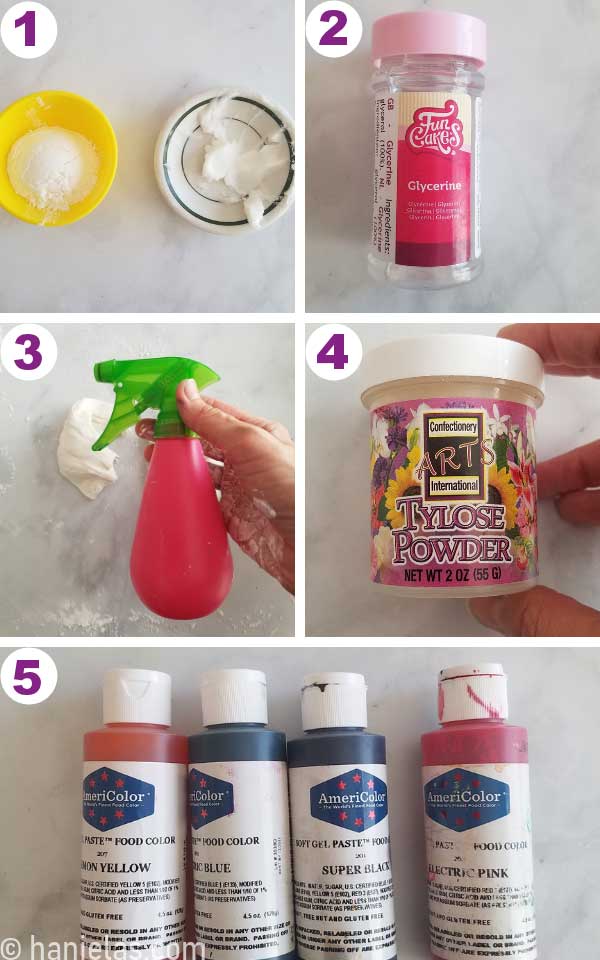
- Helpful Ingredients for Working with Fondant
- Starch – Helps with stickiness and rolling out fondant.
- Glycerine – It acts as a humectant and plasticizer, helping keep the fondant flexible and preventing tearing.
- Tylose Powder – This white powder is used to make quick gumpaste and to speed up fondant drying time.
- Concentrated Gel Colors – Use these to color fondant. Avoid liquid food colorings.
MELT MARSHMALLOWS
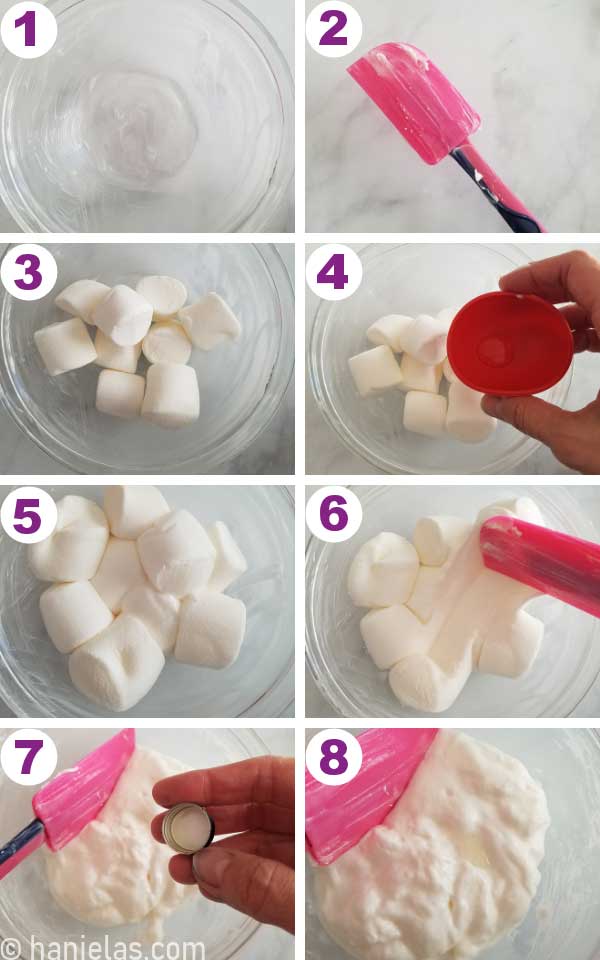
Lightly coating the bowl with vegetable shortening helps prevent sticky melted marshmallows from clinging. Start by greasing a microwave-safe bowl and a spatula with shortening. I use a little of Crisco shortening, which is white and flavorless (steps 1-2).
As shown in the photos, I used regular-size marshmallows with room-temperature water. The amount of water can vary depending on how fresh the marshmallows are—if they feel a bit dry, add an extra teaspoon or two, but not too much (step 3-4).
If you don’t have a microwave, you can melt the marshmallows over a pot of simmering water. Whichever method you use, keep a close eye on them to avoid overheating. Heat in short 20-second intervals in the microwave, stirring frequently with a lightly greased spatula. Marshmallows will puff up as they heat and won’t fully lose their shape until stirred, so regular mixing is important (steps 5-6).
You can stop heating once about three-quarters of the marshmallows are melted, but continue stirring, and the residual heat will melt the rest. This helps prevent overheating, which can make the fondant overly sticky. At this stage, you can also add flavorings. I usually use a bit of vanilla, almond, or lemon extract (steps 7-8).
ADD POWDERED SUGAR
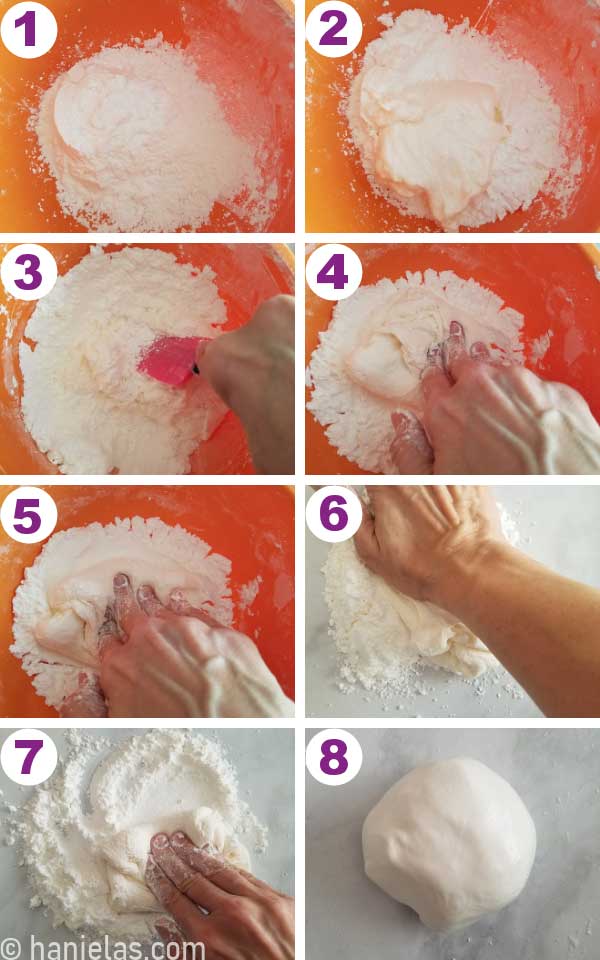
In this step, you’ll combine the melted marshmallows with powdered sugar. I always add the melted marshmallows to a bowl of powdered sugar, so have it ready before you begin. Make a well in the sugar and pour the melted marshmallow mixture into it (steps 1-2).
To handle the sticky mixture, use a greased spatula to start mixing the marshmallows with the sugar. Once it begins to come together, grease your hands with vegetable shortening and knead the dough, first in the bowl, then on a work surface, until smooth, soft, and flexible, about 5-10 minutes (steps 3-7). Shape into a ball (step 8). Freshly made fondant should be pliable, flexible, and not overly sticky. Slightly sticky is normal.
RESTING, STORING SOFTENING FONDANT
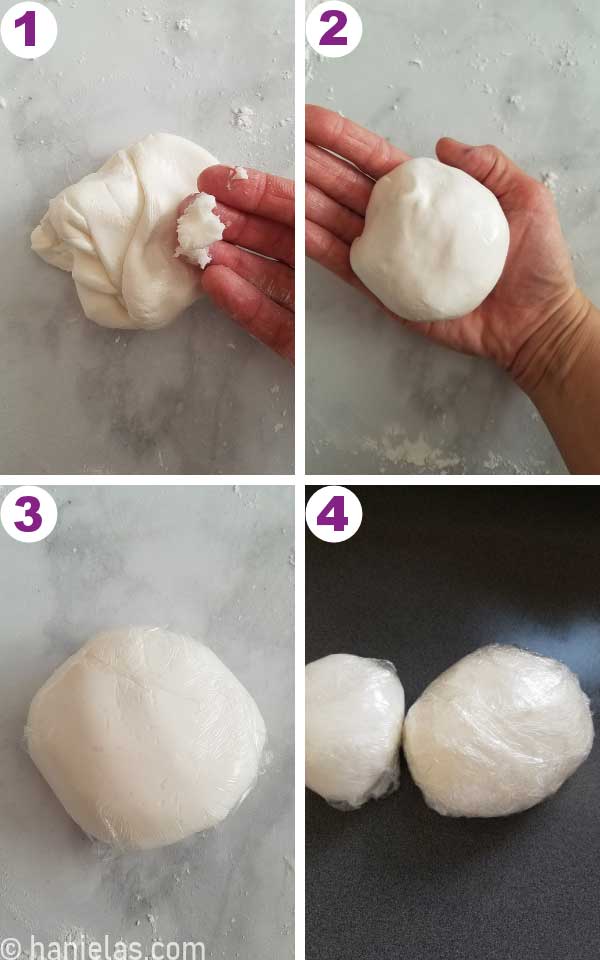
For the best results, I like to let it rest overnight before using as this makes it much easier to handle. Generously coat the fondant with vegetable shortening to lock in moisture and prevent it from drying out (steps 1-2). Wrap it tightly in plastic wrap, then place it in a Ziploc bag with as much air as possible removed.
Marshmallow fondant keeps at room temperature for 2-4 weeks and in the fridge for up to 2 months. Please keep it away from smelly foods like fish. Let it come to room temperature before using. If you are in a pinch, you can use a microwave in 3-second intervals to soften it up a bit faster.
HOW TO COLOR MARSHMALLOW FONDANT
- Method 1: Color Melted Marshmallow – great if you need a large batch of the same color
- Method 2: Color Pre-Made Fondant
COLORING MELTED MARSHMALLOWS
The easiest and most effective way to color fondant is to add color to the melted marshmallows before mixing in the powdered sugar. This works especially well for bold shades like pink, red, purple, orange, and even black, especially if you need a large amount of fondant of the same color. The warmth of the melted marshmallows helps develop deeper, more vibrant colors. Start with a small amount of food coloring and then add more to achieve more vibrant results.
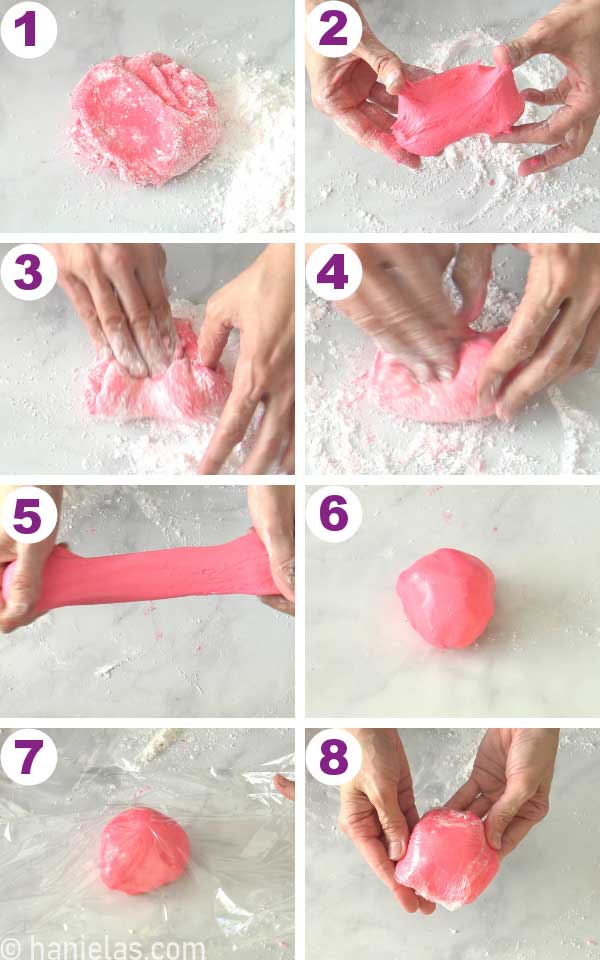
Add concentrated gel food coloring to the melted marshmallows (steps 1-4) and mix well. Pour the colored marshmallow mixture over the powdered sugar (step 5), then use a well-greased spatula to combine everything until incorporated (step 6). Once the mixture forms a mass, knead it with greased hands (steps 7-8).

Turn it out onto a work surface and continue kneading until smooth, pliable, and flexible. If it feels too sticky, keep kneading and add a little vegetable shortening and starch as needed (steps 2-3). Shape into a ball, lightly coat with vegetable shortening, and wrap tightly in plastic wrap to prevent it from drying out. Let it rest, and it is ready for your project.
COLOR PRE-MADE FONDANT
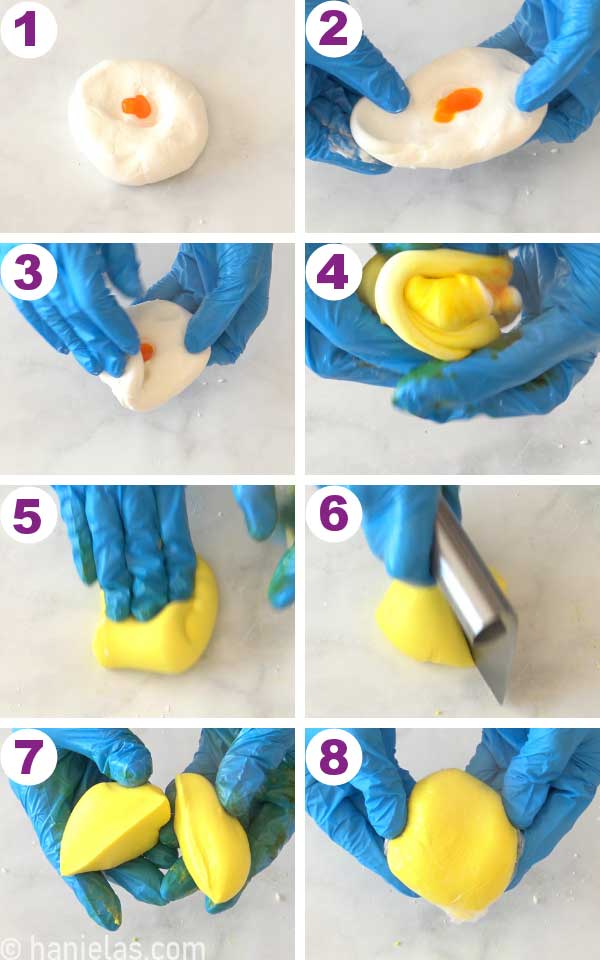
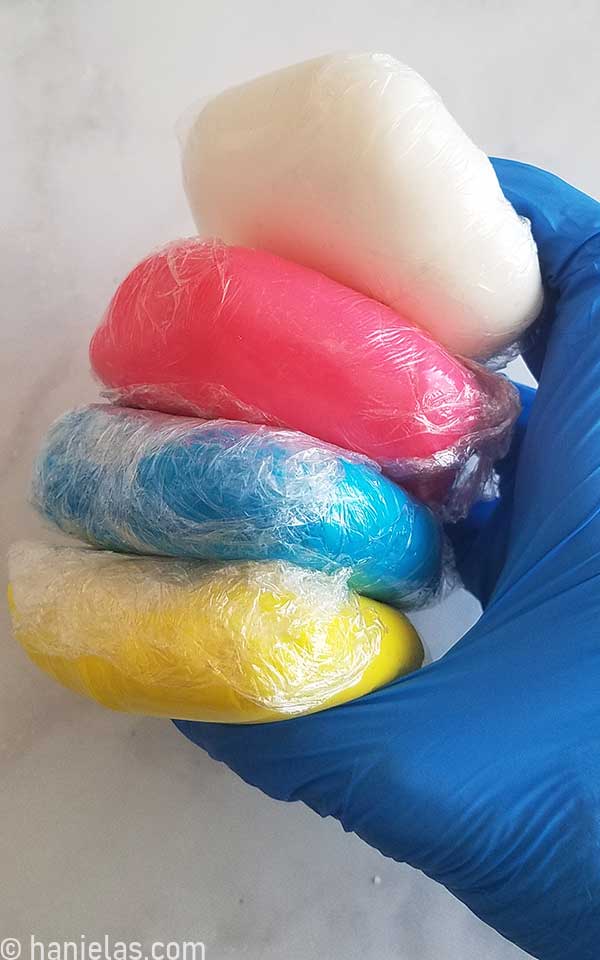
If you already have white marshmallow fondant prepared, you can easily color it using concentrated gel food coloring. I highly recommend wearing gloves for this step. Flatten the fondant, make a small well in the center, and add the gel food coloring. Knead until the color is fully and evenly distributed throughout. Use starch and vegetable shortening if it becomes too sticky.
To check consistency, cut the ball of fondant in half and examine the inside. If the color is still uneven, continue kneading and test again until fully uniform (steps 1–8).

CAN THIS RECIPE BE DOUBLED?
Yes, I have successfully doubled and even tripled this recipe. When making a large cake, for example, a 3-tier cake in one color, it’s best to color all the fondant at once. It’s nearly impossible to match the color once you run out.
When doubling or tripling this recipe, use a large bowl or a spacious cooking pot to ensure there’s enough room for all the powdered sugar and melted marshmallows.
HOW MUCH FONDANT DO I NEED TO COVER THE CAKE?
Here is a useful fondant chart (via Wilton.com) for different cake sizes.
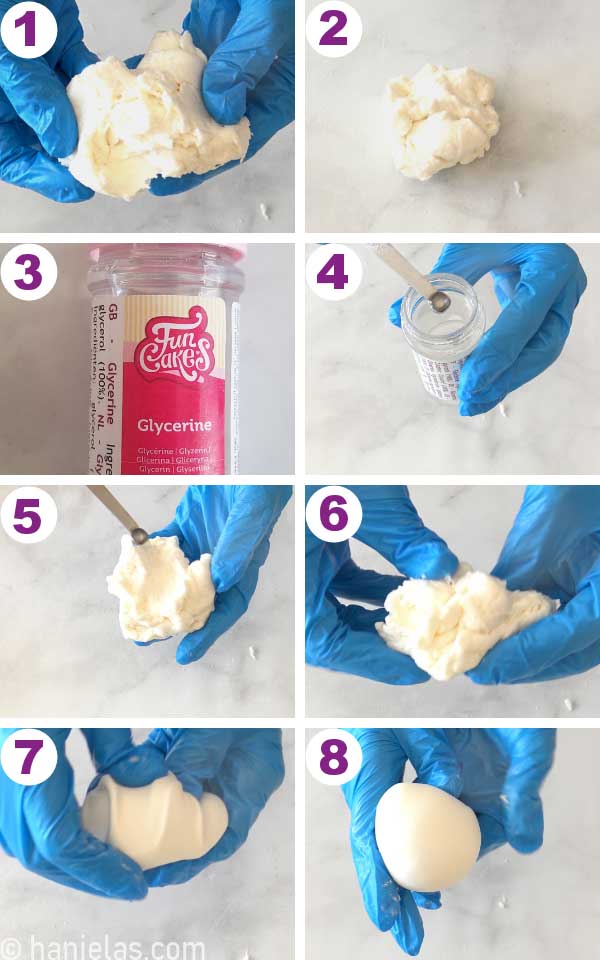
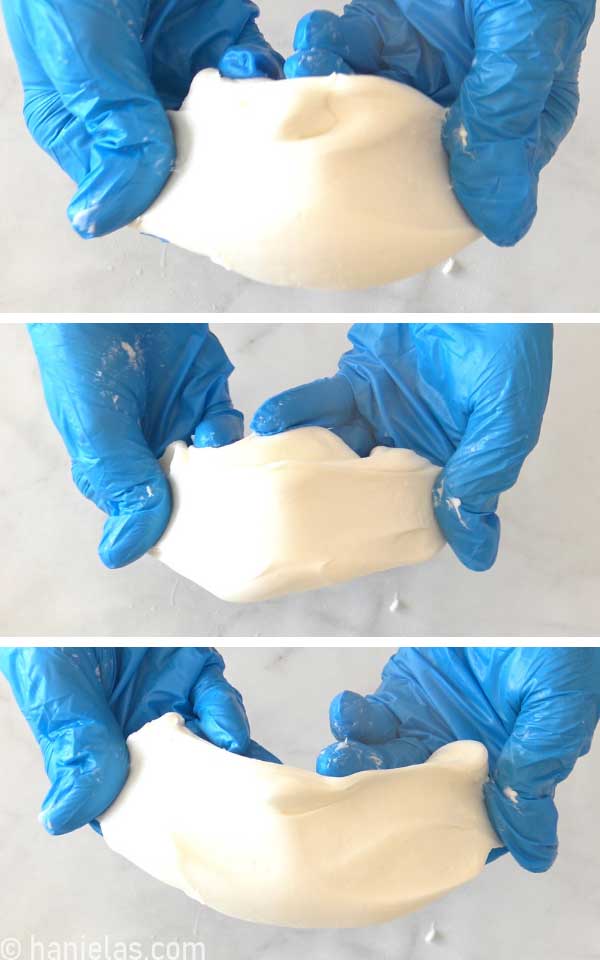
HOW TO FIX FONDANT THAT CRACKS, TEARS, ELEPHANT SKIN
From my experience, cracking and tearing usually happen when the fondant doesn’t have enough moisture. It could be due to too much powdered sugar, older marshmallows, or leaving the rolled fondant out for too long, which can cause it to lose flexibility. Cracked or tearing fondant is difficult to work with, but there are a few things you can do to fix cracking, tearing, and even “elephant skin.”
- Use Water and Vegetable Shortening – Spray dry fondant with water, then knead it with a little vegetable shortening. Hydrating fondant with water helps improve its texture and address the elephant skin problem (steps 1-8).

- Use Glycerin – I know, not everyone keeps glycerin on hand. But if you have it in your pantry now, it’s time to use it. Glycerin is a type of moisturizing agent that draws moisture from the air. Kneading it into dry, cracked fondant helps restore its texture, smoothness, and elasticity. Add a small amount of glycerin to the fondant and knead it well until it becomes pliable and smooth. I often use a little vegetable shortening to help with kneading (steps 1-8).
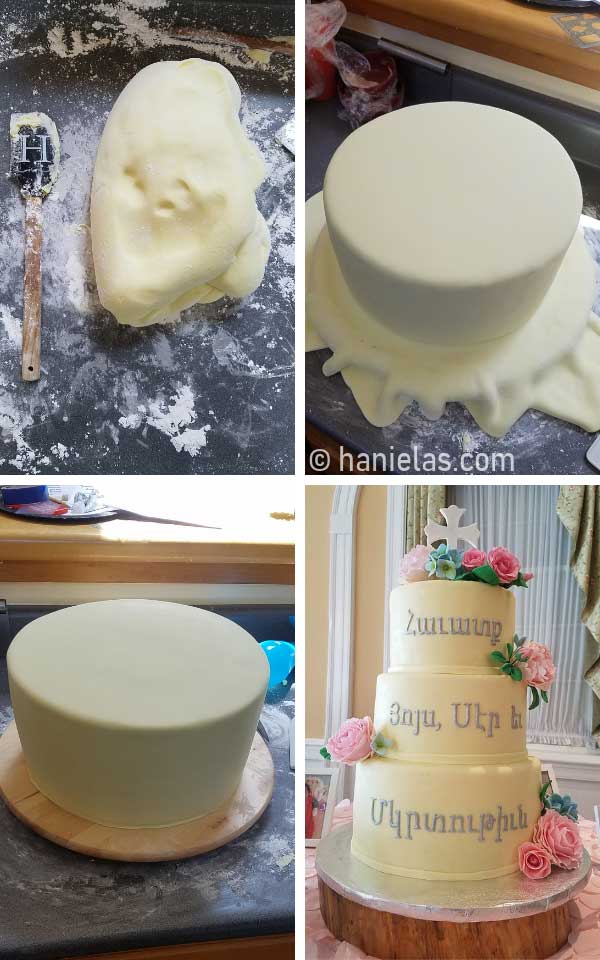
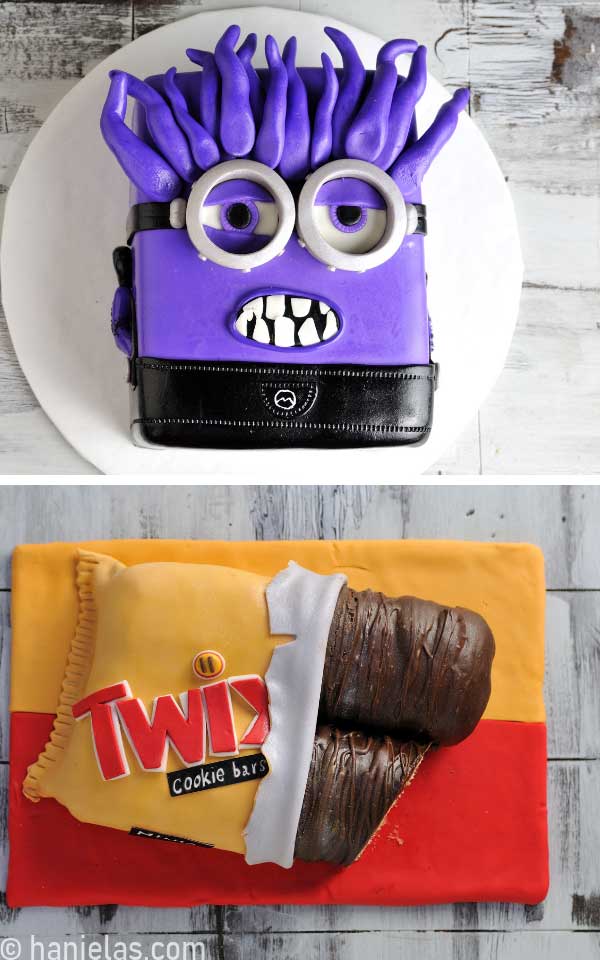
CAN YOU COVER A CAKE WITH MARSHMALLOW FONDANT?
Absolutely, I use this fondant to cover all my cakes. How to cover a cake with fondant step-by-step via Wilton.com.

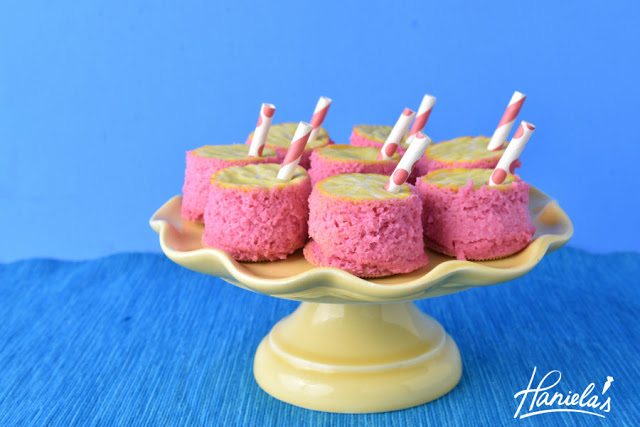
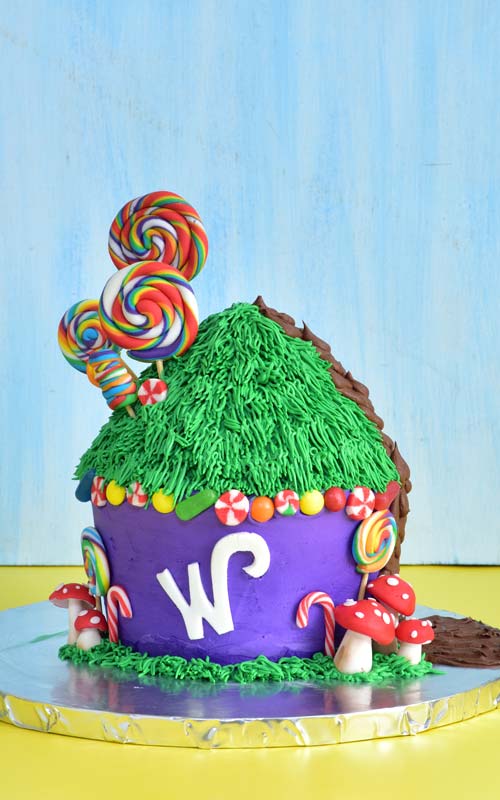
Here are cakes I decorated using marshmallow fondant and quick gumpaste.

DOES MARSHMALLOW FONDANT HARDEN?
Marshmallow fondant can take a few days to dry completely. You can speed up the process by adding tylose to make a quick gumpaste. To improve airflow and help it dry evenly, place fondant decorations on a splatter guard so air can circulate from underneath.
MARSHMALLOW FONDANT FAQ
Marshmallow fondant can be made with mini or big marshmallows.
Yes, this recipe can be easily doubled.
It needs moisture. Use water with a little vegetable shortening or glycerin, and knead it into the fondant until it’s elastic and smooth.
It could be caused by over-kneading. Loosely cover it and let it sit for 20 minutes. Then try using it again. Try kneading in more powdered sugar, along with a little starch and vegetable shortening.
You can color melted marshmallows before you add powdered sugar. Or color it after it’s been kneaded. Use concentrated gel food colors.
Yes, you can use it to make fondant cookies.
Knead in a little bit of Tylose powder. Use 1 to 1 and 1/2 teaspoons of tylose powder to 1/2 lb (226 grams) of fondant. Place your fondant decorations on a splatter guard to improve airflow and speed up drying.
Yes, absolutely.
It keeps well covered at room temperature for 2-4 weeks or in the fridge for up to 2 months. Store it away from smelly foods like fish. Let it come to room temperature before using. To soften very firm fondant quickly, you can microwave it for 3-5 seconds and knead it before using.

Marshmallow Fondant Recipe
Ingredients
MARSHMALLOW FONDANT RECIPE
- 16 oz. mini or regular size marshmallows (453grams)
- 2 pounds powdered sugar (907grams, about 8 cups)
- 2-5 tbsp water
- 1 tsp Vanilla Extract or Almond, Lemon (optional)
- 1/2 cup vegetable shortening – Crisco or another kind
SMALL BATCH MARSHMALLOW FONDANT
- 4 oz. mini or regular size marshmallows (115grams)
- 1/2 pound powdered sugar (227grams, about 2 cups)
- 1 tbsp water
- 1/4 tsp Vanilla Extract or Almond, Lemon (optional)
- 3 tbsp vegetable shortening – Crisco or another kind
MINI BATCH MARSHMALLOW FONDANT
- 2 oz. mini or regular size marshmallows (60grams)
- 1/4 pound powdered sugar (113grams about 1 cup)
- 1/2 tsp water
- 1/8 tsp Vanilla Extract or Almond, Lemon (optional)
- 2 tbsp vegetable shortening – Crisco or another kind
Instructions
Marshmallow Fondant
- Instructions are the same for all 3 recipes.
- Into a large mixing bowl pour powdered sugar, if you see any lumps, be sure to sift it (regular batch: 2 pounds, 907grams, about 8 cups; small-batch: 1/2 pound, 227grams, about 2 cups; mini-batch: 1/4 pound, 113grams, about 1 cup). Make a well in the center. Set aside.
- Grease a spatula and a microwave-safe bowl with vegetable shortening.
Melt Marshmallows
- Into a greased bowl pour marshmallows (regular batch: 16oz, 453grams; small-batch: 4oz,115grams ; mini-batch: 2oz, 60grams). Pour water over marshmallows (regular batch: 2-5 tablespoons ; small-batch: 1 tablespoon ; mini-batch: 1/2 tablespoon).If you are using marshmallows that are not super fresh and really soft and moist, you may need to add more water.Microwave on high in 20- second intervals until all of the marshmallows are melted. They will puff up when heated and they don't look melted until you use a spatula and stir them.
- Stir melted marshmallows with a greased spatula, add Extract if using (regular batch: 1 teaspoon Vanilla; small-batch: 1/4 teaspoon; mini-batch: 1/8 teaspoon). Stir well.
Coloring
- If you need just one color of fondant, you can add concentrated gel food coloring to melted marshmallows and stir well until homogeneous. Continue with the next step. Or skip the color and make white fondant and color it later.
Kneading
- Pour all of the melted marshmallows into a bowl with powdered sugar (regular batch: 2 pounds, 907grams; small-batch:1/2pound, 227grams, about 2cups; mini-batch: 1/4pound, 113grams, about 1cup).
- Take the spatula or a wooden spoon coated with Crisco and roughly combine the powdered sugar with marshmallows. Then using your hands, lightly coated with shortening, knead the marshmallow fondant like you would bread dough until it's smooth and flexible 5-10 minutes.If the mixture is tearing a lot, add a few drops of water and knead it in. Or knead in some glycerin. Shape it into a ball, and flatten it slightly.For more tips please refer to the section Marshmallow Fondant FAQ in the blog post.
Storage
- Generously coat marshmallow fondant with vegetable shortening. Double wrap it tightly with a food wrap and seal it in a resealable Ziploc bag, with the air squeezed out. Let freshly made marshmallow fondant rest overnight before using. If you are short on time, allow a couple of hours of rest. Store at room temperature for 2-4 weeks and in the fridge for up to 2 months. If refrigerating bring it to room temperature before using. Or microwave in 3-5 second intervals until more pliable. Don't overheat.
Video
Notes

Hi, I’m Hani
Welcome!
Thank you for visiting Haniela’s. On my blog, you’ll find delicious sweet & savory recipes made with simple ingredients. Why not start a new adventure? Discover a world of cookie decorating with my step-by-step tutorials.

Hi, I’m Hani
Welcome!
Thank you for visiting Haniela’s. On my blog, you’ll find delicious sweet & savory recipes made with simple ingredients. Why not start a new adventure? Discover a world of cookie decorating with my step-by-step tutorials.


It’s a good idea
Thank you.